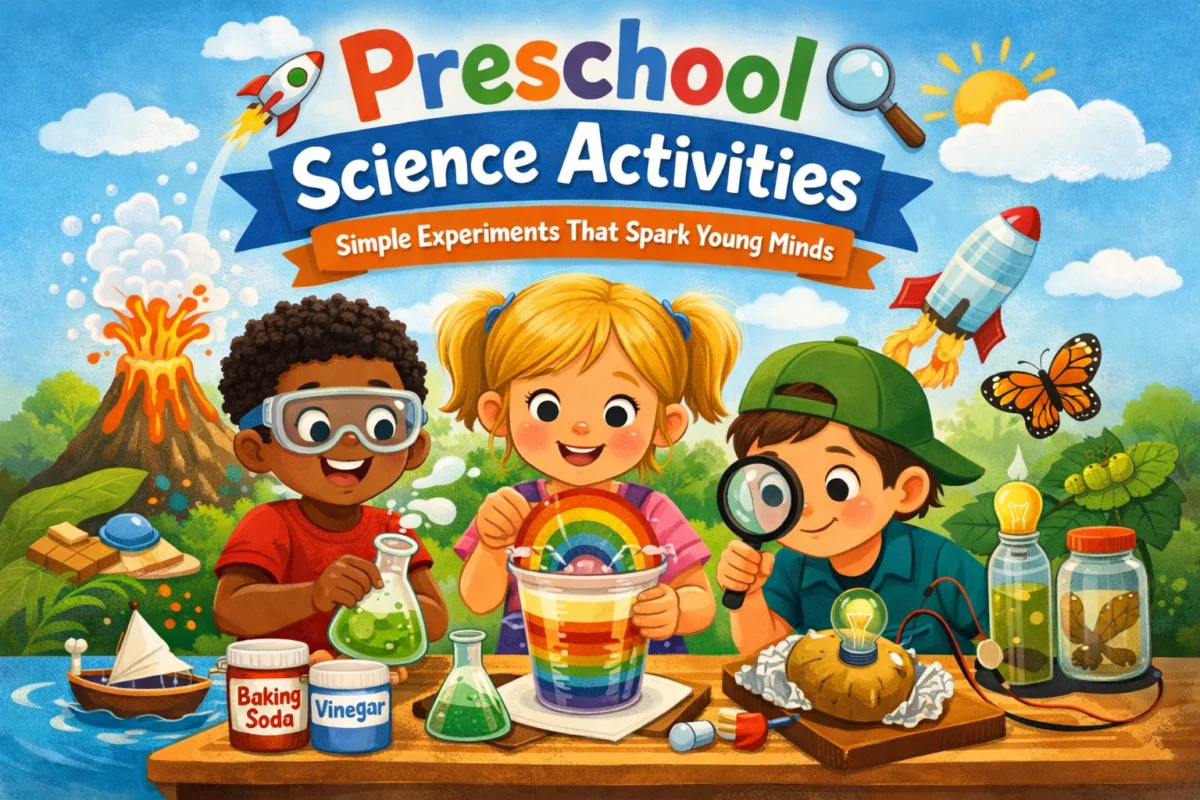
Preschool Science Activities: Simple Experiments That Spark Young Minds
Your preschooler asks “why” about everything. That curiosity is a gift, and science activities transform it into hands-on learning. These early experiments build critical thinking skills while keeping little ones engaged through play.
This guide shares practical, mess-friendly experiments you can set up in minutes. You will discover how everyday materials become powerful teaching tools. Each activity nurtures observation skills and problem-solving abilities that prepare children for lifelong learning.
Why Science Matters in Early Childhood
Young children are natural scientists. They touch, taste, observe, and question everything around them. Harnessing this innate curiosity through structured activities strengthens their cognitive development.
Science experiments teach cause and effect. When a child mixes baking soda with vinegar and watches it fizz, they learn actions have predictable results. This foundation supports math skills, reading comprehension, and logical reasoning later in school.
Research shows early STEM exposure increases confidence in these subjects. Children who engage with science activities for preschoolers develop patience, focus, and the ability to follow multi-step directions. These skills transfer across all learning areas.
Also Read : Preschool at 2, 3, or 4 Years Old: Which Age Is Actually Better?
Setting Up Your Home Science Space
You do not need a laboratory. A kitchen table, some towels, and basic supplies create the perfect learning environment. Keep materials organized in clear bins so children can see what is available.
Safety comes first. Always supervise experiments, especially those involving heat or small objects. Choose age-appropriate activities that match your child’s developmental stage and attention span.
Stock up on versatile supplies: measuring cups, clear containers, food coloring, baking soda, vinegar, dish soap, and cornstarch. Most preschool activities science experiments require items you already have at home.
Water and Ice Exploration
Floating and Sinking
Fill a large bowl with water and gather household items: a cork, a rock, a plastic toy, a metal spoon, and a sponge. Ask your child to predict which items will float before testing each one.
This simple activity teaches density concepts without complex vocabulary. Children observe patterns and begin categorizing objects based on their properties. Extend learning by trying fruits and vegetables from your kitchen.
Ice Melting Magic
Freeze small toys or natural items like flowers inside ice cubes. Place them in a shallow tray and provide warm water, salt, and droppers. Children experiment with different melting methods while developing fine motor skills.
The anticipation builds as ice slowly reveals hidden treasures. This teaches patience and demonstrates how temperature affects matter. Add food coloring to the warm water for extra visual appeal.
Color Mixing in Water
Set out three clear cups with water. Add primary colors (red, yellow, blue) using food coloring. Give your child empty cups and encourage them to pour and mix, discovering secondary colors.
This science activity for preschoolers introduces basic chemistry through play. Children see immediate results and can repeat the experiment with different ratios. Document their findings with photos or simple drawings.
Also Read : Summer Camp Activities That Keep Kids Engaged All Season Long
Kitchen Chemistry Adventures
Volcano Eruptions
Build a volcano using playdough or clay around a small cup. Add baking soda, a drop of dish soap, and food coloring to the cup. Pour vinegar and watch the chemical reaction create foaming lava.
This classic never gets old. The dramatic reaction captivates children while demonstrating gas formation. Discuss how real volcanoes work and show pictures of different volcano types worldwide.
Oobleck Sensory Play
Mix two cups of cornstarch with one cup of water in a large tray. This non-Newtonian fluid acts solid under pressure but liquid when handled gently. Children love the surprising texture.
Oobleck teaches that materials can have unique properties. It supports sensory development and provides calming tactile input. Add toy dinosaurs or cars for imaginative play scenarios.
Fizzing Colors
Place baking soda in a muffin tin, adding different food coloring to each cup. Provide droppers filled with vinegar. Children squeeze vinegar into the baking soda, creating individual colorful reactions.
This setup allows multiple experiments without constant adult intervention. Kids practice fine motor control with droppers while exploring color combinations and chemical reactions repeatedly.
Nature-Based Discovery
Seed Sprouting
Place damp paper towels in a clear plastic bag. Add bean seeds between the towel and bag so children can observe roots and shoots developing. Tape the bag to a sunny window and watch daily changes.
Plant growth fascinates young learners. They see life cycles in action and learn that living things need water, light, and time. Transfer successful sprouts to soil and continue the growing journey.
Leaf Collection and Sorting
Gather leaves during a nature walk. Back home, sort them by size, shape, color, or texture. Use magnifying glasses to examine veins and edges closely.
This fall science activities for preschoolers connects children to seasonal changes. Classification skills develop as they identify patterns and differences. Press favorite leaves in books to preserve them.
Rock Observation
Collect various rocks and provide magnifying glasses, water, and white paper. Children observe how water changes rock appearance and discover hidden colors or patterns when wet.
Geology becomes accessible through hands-on exploration. Discuss where rocks come from and how weather changes them over time. Create a rock collection display with handwritten labels.
Physics Fun for Little Ones
Ramp Racing
Build ramps using cardboard or wooden blocks at different angles. Race toy cars down each ramp, measuring which angle makes cars travel fastest or farthest.
This science activity preschool experiment introduces gravity, force, and motion. Children make predictions, test them, and draw conclusions. Change variables like ramp height or car weight for extended learning.
Magnetic Discovery
Provide magnets and a collection of items: paper clips, plastic toys, wooden blocks, metal spoons, and aluminum foil. Children test which items magnets attract and create sorted piles.
Magnetism seems like magic to preschoolers. This hands-on exploration reveals invisible forces at work. Hide metal objects under paper or fabric and let children use magnets to locate them.
Balance Experiments
Create a simple balance using a ruler and a block as a fulcrum. Children place objects on each end, discovering which items weigh more through direct comparison.
Weight and balance concepts emerge through play. This activity science for preschool develops mathematical thinking and estimation skills. Progress to using actual scales for more precise measurements.
Bubble Science
Giant Bubble Solution
Mix six cups of water, one cup of dish soap, and one tablespoon of glycerin or corn syrup. Let the solution rest overnight for best results. Create bubble wands from pipe cleaners or use store-bought options.
Bubble experiments teach surface tension and air properties. Children observe rainbow colors in bubble surfaces and learn why bubbles are always round. Experiment outdoors for less mess.
Bubble Painting
Add food coloring to bubble solution in shallow dishes. Children blow bubbles through straws onto white paper, creating unique prints as bubbles pop. Each print becomes a colorful work of art.
This combines science with creativity. Discuss why bubbles pop and what leaves the colored marks behind. Display finished artwork to celebrate their scientific and artistic achievements.
Air and Wind Activities
Parachute Drop
Create parachutes using coffee filters, string, and small toys. Children drop them from heights, observing how air resistance slows the fall. Compare parachutes of different sizes.
This demonstrates gravity and air resistance concepts. Children see that larger parachutes fall more slowly. Time each drop with a stopwatch for math integration and data collection practice.
Straw Rockets
Cut paper into small rectangles and tape them around straws to create rockets. Place a second straw inside and blow hard to launch the rocket. Measure flight distances.
Engineering meets physics in this engaging activity. Children adjust designs to improve performance, learning through trial and error. Hold competitions to see whose rocket flies farthest.
Weather Watching
Rain Cloud in a Jar
Fill a clear jar three-quarters full with water. Top with shaving cream to represent clouds. Drop blue food coloring onto the cream and watch it seep through like rain.
This visual demonstration explains precipitation simply. Children see how clouds hold water until they become too heavy. Connect this experiment to real weather observations outside.
Wind Sock Creation
Decorate paper bags or fabric tubes with markers and ribbons. Hang them outside to observe wind direction and strength throughout the day.
Weather observation becomes interactive. Children check their wind socks regularly, noting changes and patterns. Discuss how wind helps plants spread seeds and sailors move boats.
Also Read : What Should I Do If My Child Refuses to Join Group Activities at Camp?
Documentation and Learning Extension
Keep a science journal with photos and simple descriptions of each experiment. Children can draw what they observed or dictate their findings to you. This builds literacy skills while reinforcing scientific concepts.
Revisit favorite experiments with slight variations. Change one variable and predict new outcomes. This scientific method practice develops critical thinking without feeling like formal lessons.
Connect experiments to books about related topics. A library trip after doing plant experiments deepens understanding. Stories bring scientific concepts to life through narrative and illustration.
Building Science Routines
Designate one day weekly as science day. Consistency helps children anticipate and prepare for experiments. They learn to think scientifically as a regular part of their routine.
Rotate between different science types: chemistry one week, physics the next, then nature studies. This variety maintains interest while building broad scientific knowledge across multiple disciplines.
Invite friends or siblings to join experiments. Peer learning enhances the experience as children explain their observations to others. Group activities also teach collaboration and sharing of materials.
Connecting Science to Summer Camps
These hands-on experiences prepare children for structured learning environments. When kids attend summer camps, they arrive confident in exploration and comfortable with asking questions.
Programs focusing on STEM education build upon the foundation you create at home. Children who have experimented with easy science activities for preschoolers transition smoothly into more complex camp projects.
Look for camps that emphasize inquiry-based learning rather than passive instruction. Active participation solidifies understanding and keeps young learners engaged throughout longer program days.
Troubleshooting Common Challenges
Experiment Fails
Not every experiment works perfectly the first time. Model resilience by discussing what went wrong and how to adjust. Failed experiments teach valuable lessons about persistence and problem-solving.
Review instructions together and identify where changes might help. This analytical thinking serves children well beyond science activities. Celebrate attempts regardless of outcomes.
Short Attention Spans
Preschoolers have limited focus. Choose experiments that complete within 10-15 minutes initially. Build up to longer activities as attention spans develop and interest deepens.
Break complex experiments into smaller steps across multiple days. This maintains enthusiasm while preventing frustration. Children enjoy returning to unfinished projects and seeing progress over time.
Messy Situations
Embrace the mess as part of learning. Lay down plastic tablecloths or move activities outdoors when possible. Cleanup becomes part of the experiment process and teaches responsibility.
Provide child-sized cleaning tools so kids can help restore order. This practical life skill complements the scientific learning. Make cleanup fun with songs or races.
Conclusion
Science opens windows to understanding our world. These preschool science activities transform everyday moments into powerful learning opportunities. Your child develops skills that reach far beyond individual experiments.
Start with one activity this week. Watch your preschooler’s eyes light up with discovery. That spark of curiosity, carefully nurtured, becomes a lifelong love of learning and exploration. The simple act of asking questions and seeking answers shapes how children approach challenges throughout their lives.
FAQ: Preschool Science Activities
What are the best science activities for preschoolers to try at home?
The best experiments use household items and produce quick, visible results. Try baking soda volcanoes, color mixing, ice melting, and magnetic discovery. These activities require minimal preparation and maintain attention through immediate reactions and hands-on engagement.
How do science experiments benefit preschool-aged children?
Science activity for preschool builds observation skills, critical thinking, and problem-solving abilities. Children learn to make predictions, test ideas, and draw conclusions. These cognitive skills transfer to reading, math, and social situations while boosting confidence in learning environments.
What materials do I need for easy science activities for preschoolers?
Stock basic supplies like baking soda, vinegar, food coloring, measuring cups, clear containers, and magnifying glasses. Most science preschool activities use kitchen items you already own. Add cornstarch, dish soap, and a few magnets for expanded experiment options.
How long should preschool science activities last?
Keep initial experiments between 10-15 minutes to match preschooler attention spans. As interest grows, extend activities or break complex experiments into multiple short sessions. Follow your child’s engagement cues rather than forcing completion of predetermined timeframes.